

An intermediate roll is a middle-layer roll installed between the work roll and the Backup Roll in a multi-roll cold rolling mill, most commonly in 12-high and 20-high configurations such as the Sendzimir mill.
In a standard four-high mill you have two layers of Rolls: a work roll on top of a backup roll. That works fine for many products. But when you need to roll thin, hard, or wide strip, the work roll has to stay very small in diameter to keep the rolling load low and the reduction high. A small work roll is weak and bends easily, so it cannot handle the load alone. That is where the intermediate roll comes in.
A 20-high mill, for example, stacks two layers of intermediate rolls above each work roll. The first intermediate rolls sit directly on the work roll, and the second intermediate rolls sit above them, supported by the saddle bearings and the backup roll assembly. Every layer carries part of the load and gives the mill its stiffness.
The Main Functions of the Intermediate Roll
The intermediate roll does more than one job, and each job matters for a different reason.
1. Transferring the Rolling Force
The most basic function is mechanical. The rolling force generated by the mill housing has to travel down to the work roll, and the intermediate roll is the link in the middle. It spreads the concentrated load from the backup bearings across a wider contact area so the small work roll is not crushed or deflected beyond its limit.
Without this layer, the load would concentrate on a narrow line and the work roll would bend, producing strip that is thick in the middle and thin at the edges. The intermediate roll spreads that pressure evenly, which is exactly what you need for consistent thickness across the strip width.
2. Controlling Strip Shape and Flatness
This is the function most operators care about. In many multi-roll mills, the intermediate roll can be shifted axially, meaning it slides sideways along its length while the mill is running.
Why does that matter? Because the gap between the work rolls is not perfectly uniform across the width. Heat, roll wear, and incoming strip profile all change the shape of the gap. By shifting the intermediate roll, you move the effective roll contour toward the strip edges, changing the pressure there. This lets you correct waves, buckles, and center or edge strain while the strip is still in the mill.
In simple terms, axial shifting of the intermediate roll is one of the fastest and most reliable ways to keep the strip flat, and it can be adjusted without changing rolls or stopping the line.
3. Supporting the Work Roll and Reducing Bending
A thin work roll bends under load, and the bend shows up directly in the strip profile. The intermediate roll holds the work roll up along its length, dramatically cutting the amount of bending. With better support, the mill can roll wider and harder material while keeping a tighter thickness tolerance.
This support also means the work roll does not have to be stiffened by increasing its diameter. You keep the small work roll that gives you the reduction you want, and the intermediate roll handles the stability. It is a good balance between capability and control.
4. Protecting Surface Quality and Distributing Wear
Because the intermediate roll carries a large share of the load, it also takes a lot of the wear. By design, that wear lands on a roll that is easier and cheaper to replace than the work roll, and it protects the strip surface from the stress concentrations that cause marks and defects.
A well-maintained intermediate roll also keeps the contact pressure uniform, which reduces the chance of localized heating, roll spalling, or surface scratches on the finished strip. For people producing automotive or appliance-grade steel, this surface protection is often the difference between a good coil and a rejected one.
How Axial Shifting Actually Controls Flatness
To picture it, imagine the work roll gap as a slightly flexible surface. When the incoming strip has a heavy center, the strip runs tight in the middle and loose at the edges, which makes wavy edges. When the strip has heavy edges, you get center buckle instead.
Shifting the intermediate roll sideways changes the contact geometry near the strip edge. The angled contour of the shifted roll effectively increases or decreases pressure at the edge, pushing the strip flat. Because this happens while rolling, the operator or the automatic gauge control system can correct shape in real time, coil after coil, without losing production time.
This is why intermediate rolls in modern mills are paired with hydraulic shifting cylinders and measured by shape-meters, not adjusted by feel. The combination of precise shifting and continuous feedback is what keeps modern thin strip flat at high speed.
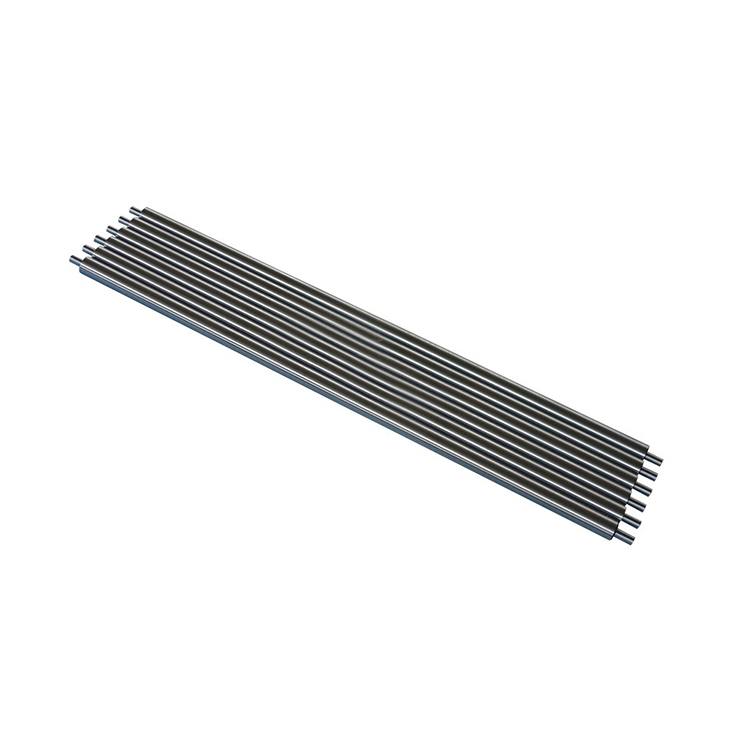
Typical Materials and Parameters
Intermediate rolls are built to take serious punishment, so material and hardness matter. Most are made from hardened alloy tool steel or high-speed steel, with a surface hardness that sits well above the work roll contact zone to resist wear and indentation.
The table below shows typical ranges you will see on a mid-size 20-high cold mill. Exact values depend on your mill design, so treat these as reference points, not specifications.
| Parameter | Typical Range | Notes |
|---|---|---|
| Roll diameter (first intermediate) | 120 – 200 mm | Sits directly on the work roll |
| Roll diameter (second intermediate) | 200 – 350 mm | Sits on saddle bearings |
| Roll body length | 800 – 2,000 mm | Matches strip width |
| Surface hardness | 58 – 65 HRC | Hardened to resist wear |
| Material | Alloy tool steel / high-speed steel | High wear resistance |
| Axial shifting stroke | 0 – 100 mm | Used for shape control |
| Surface roughness (Ra) | 0.05 – 0.4 µm | Polished, low friction |
| Roll service life | 5,000 – 20,000 tonnes | Depends on load and lubrication |
These numbers give you a sense of scale. The intermediate roll is not a small part, and it is not cheap, which is exactly why protecting it and maintaining it pays off in mill uptime and strip quality.
Frequently Asked Questions
1. Why can't a four-high mill just use a bigger work roll instead of an intermediate roll?
A bigger work roll would be stiffer, but it also increases the rolling load needed for the same reduction, which limits how thin you can go and raises power consumption. The intermediate roll lets you keep a small, high-reduction work roll while adding the support that a larger roll would provide. You get the best of both.
2. Does every cold rolling mill have an intermediate roll?
No. Four-high and some six-high mills use different arrangements, and six-high mills use an intermediate roll that can be shifted or bent for shape control. Intermediate rolls are essential in 12-high and 20-high mills, where the thin work rolls cannot survive the load on their own.
3. How often should an intermediate roll be changed?
There is no single answer. It depends on the material you roll, the load, and the lubrication. Many mills change intermediate rolls based on either surface condition or a set tonnage, often between 5,000 and 20,000 tonnes. The right interval keeps wear from hurting the strip surface.
4. Can axial shifting be done while the mill is running?
Yes, that is exactly how modern shape control works. Hydraulic cylinders shift the intermediate roll during rolling, and a shape-meter reads the strip flatness and sends corrections automatically. This real-time control is why flatness has improved so much in recent years.
5. What happens if an intermediate roll is worn or damaged?
The first sign is usually a degradation in strip shape or surface quality, sometimes with visible marks or a drop in thickness tolerance. A damaged intermediate roll can also transfer its defects to the work roll and the strip. This is why regular inspection and replacement are so important.
 Persona de contacto: Sr. Wu
 Teléfono: +86 18602539156
 Correo electrónico: wuqi231138@126.com
Copyright © 2025 Nanjing Guantai Roller Industry Co., Ltd.Desarrollado por comercio exterior yi
Mapa del sitioEste sitio web utiliza cookies para garantizar que obtenga la mejor experiencia en nuestro sitio web.
 English
 Pусский
 Indonesia
 Tiếng Việt


Comentario
(0)